
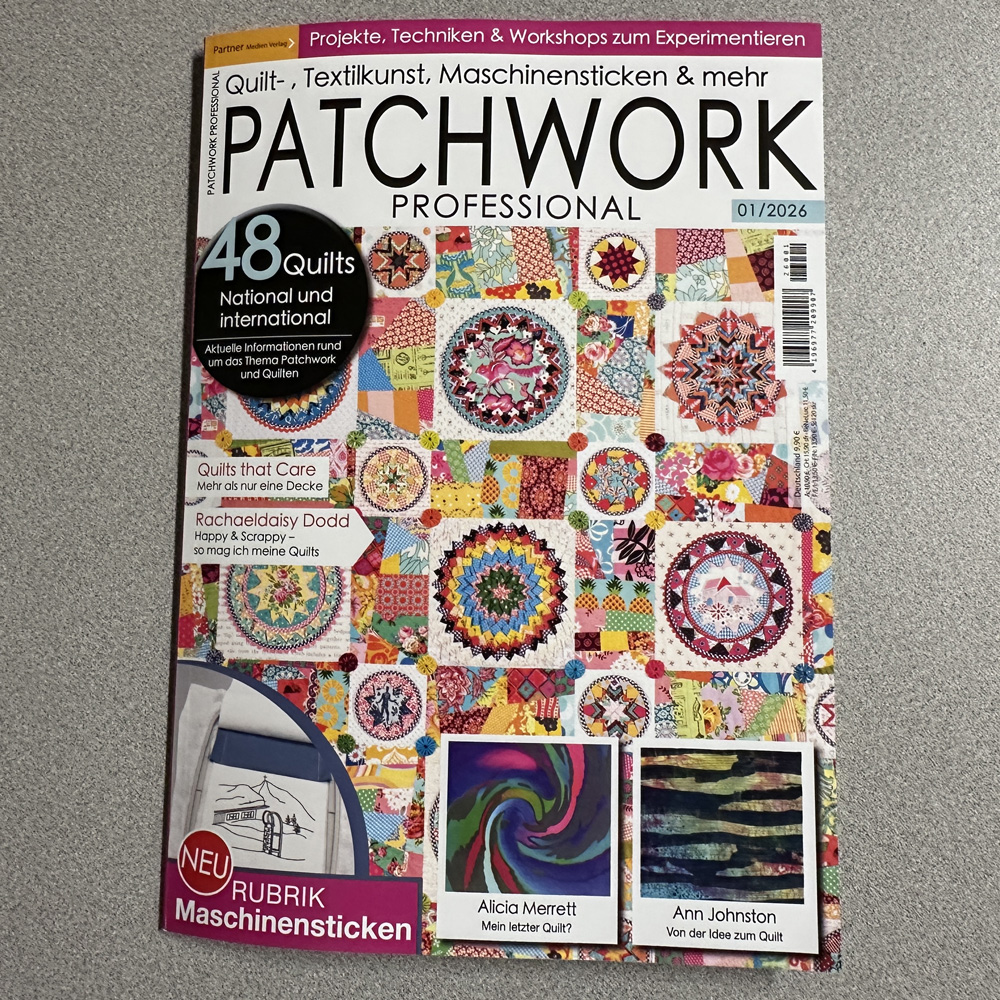
Von der Idee zum
Last summer, Dorothee Crane contacted me for an interview for the 30th anniversary issue of their Patchwork Porfessional Magazine, published in Germany by Partner Medien Verlag. We have known each other since she interviewed me in 2010 at a conference in Switzerland.
She wanted to know about my more recent work. After multiple conversations and lots of discussion about images to use, the magazine appeared in my mailbox with 8 full pages of images and the interview in German.
If you want to read a draft of the interview, I have added it in this post, below the images.
Ann’s 2025 interview with Dorothee Crane of Patchwork Professional, Germany
30th Anniversary edition, issue 1/2026, pages 12-19
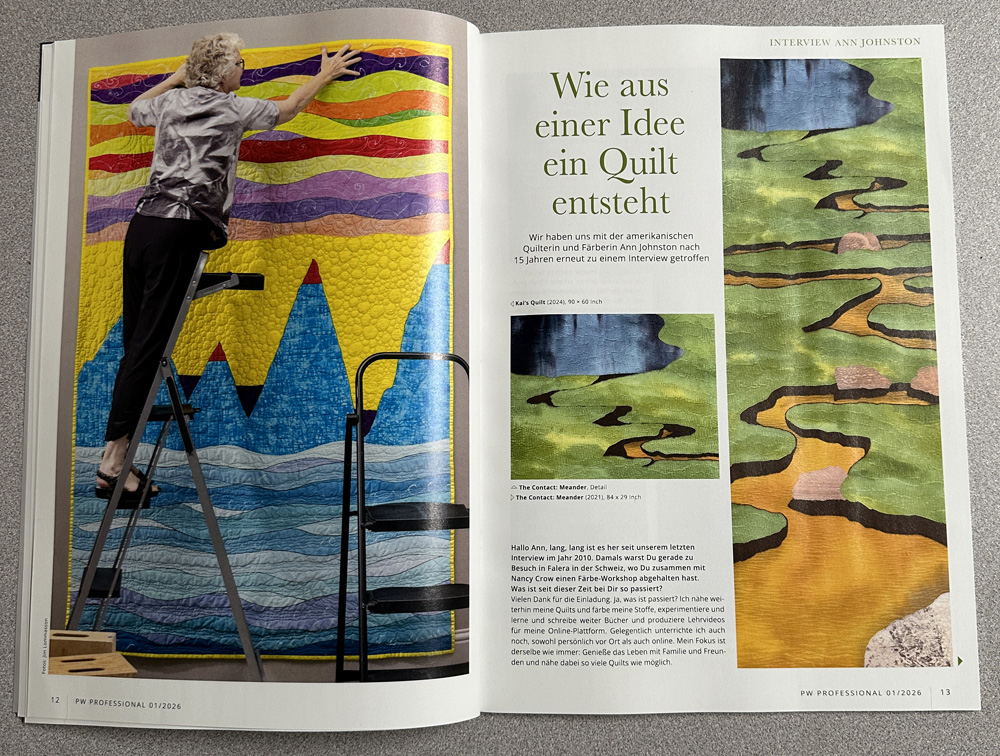
Hello Ann, it’s been a long time since our last interview in 2010. Back then, you were visiting Falera, Switzerland, where you held a dyeing workshop with Nancy Crow. What’s been happening with you since then?
Thank you for the invitation. So, what’s been happening? I continue to sew my quilts and dye my fabrics, experiment and learn, and continue to write books and produce instructional videos for my online platform. I also teach occasionally, both in person and online. My focus is the same as always: Enjoy life with family and friends while sewing as many quilts as possible.
How does your creative life influence your everyday life, and vice versa?
I find it difficult to separate the two because I am inspired by everything I see and the many things I don’t. My self-dyed fabrics, of course, also give me plenty of motivation. Ideas are everywhere, just waiting to be implemented. Motivation is not a problem for me. Not a day goes by that I don’t think about my projects, whether it’s the one I’m currently working on or what I want to tackle next. I have far too many ideas and need to take time to decide which piece I want to dedicate my time to, which I want to develop, and which I need to let go of.
Are you still working in series?
Yes, for many years I’ve been working on several series—thematic series, not visual ones. They are connected by their concept, not by color or construction. On my recently updated website, my portfolio is organized so that the viewer can find some series, for example, “The Contact,” “Wave,” “Fragment,” and “Wild Garden.” Other quilts aren’t planned as part of a series but fit into general categories like “Structure,” “Reflection,” and so on.
Could you please tell us a little more about your “The Contact” series?
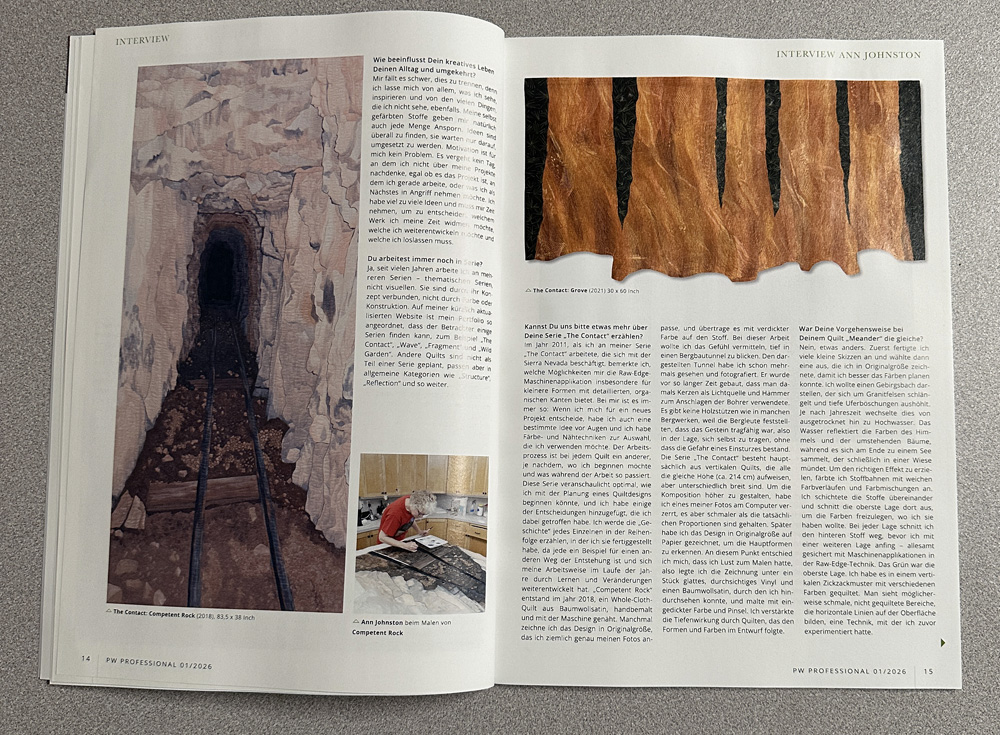
In 2011, while working on my series “The Contact,” which explores the Sierra Nevada Mountains, I realized the possibilities that raw-edge machine appliqué offered, especially for smaller shapes with detailed, organic edges. Whenever I decide on a new project, I always have a specific idea in mind and a selection of dyeing and stitching techniques I want to use. The process for each quilt is different, depending on where I want to start and what happens during the process. This series clearly illustrates how I might begin planning a quilt design, and I’ve included some of the decisions I made along the way. I’ll tell the “story” of each quilt in the order I completed them, as each one is an example of a different path to creation, and my approach has evolved over the years through learning and change.
The quilt, “Competent Rock,” was created in 2018. It’s a whole-cloth cotton sateen quilt, hand-painted and machine-sewn. Sometimes I draw the design at full size, matching it fairly closely to my photographs, and transfer it to the fabric using thickened paint. In this work, I wanted to convey the feeling of looking deep into a mining tunnel. I’ve seen and photographed the depicted tunnel several times. It was built so long ago that people used candles for light and hammers to strike the drill bits. There are no wooden supports like in some mines because the miners discovered that the rock was “load-bearing,” capable of supporting itself without danger of collapse. The “The Contact” series consists primarily of vertical quilts, all the same height (about 214 cm) but of varying widths. To make the composition taller, I distorted one of my photographs on the computer, but kept it narrower than its actual proportions. Later, I drew the design at full size on paper to identify the main shapes. At that point, I decided I felt like painting, so I placed the drawing under a piece of smooth, clear vinyl and a see-through cotton sateen, and painted over it with thickened paint and a brush. I enhanced the sense of depth by quilting, following the shapes and colors in the design.
Was your process the same for your “Meander” quilt?
No, a little different. First, I made many small sketches and then chose one to draw at full size so I could better plan the dyeing. I wanted to depict a mountain stream winding around granite boulders, carving out deep banks. Depending on the season, this changed from dry to flooded. The water reflects the colors of the sky and the surrounding trees, eventually collecting into a lake that eventually flows into a meadow. To achieve the right effect, I dyed lengths of fabric using soft gradients and color blends. I layered the fabrics on top of each other and cut out the top layer to expose the colors where I wanted them. For each layer, I cut away the backing fabric before starting another layer—all secured with machine appliqué using the raw-edge technique. The green was the top layer. I quilted it in a vertical zigzag pattern using different colors. You may see narrow unquilted areas forming horizontal lines on the surface, a technique I had experimented with before.
Then please also explain how “The Grove” came about.
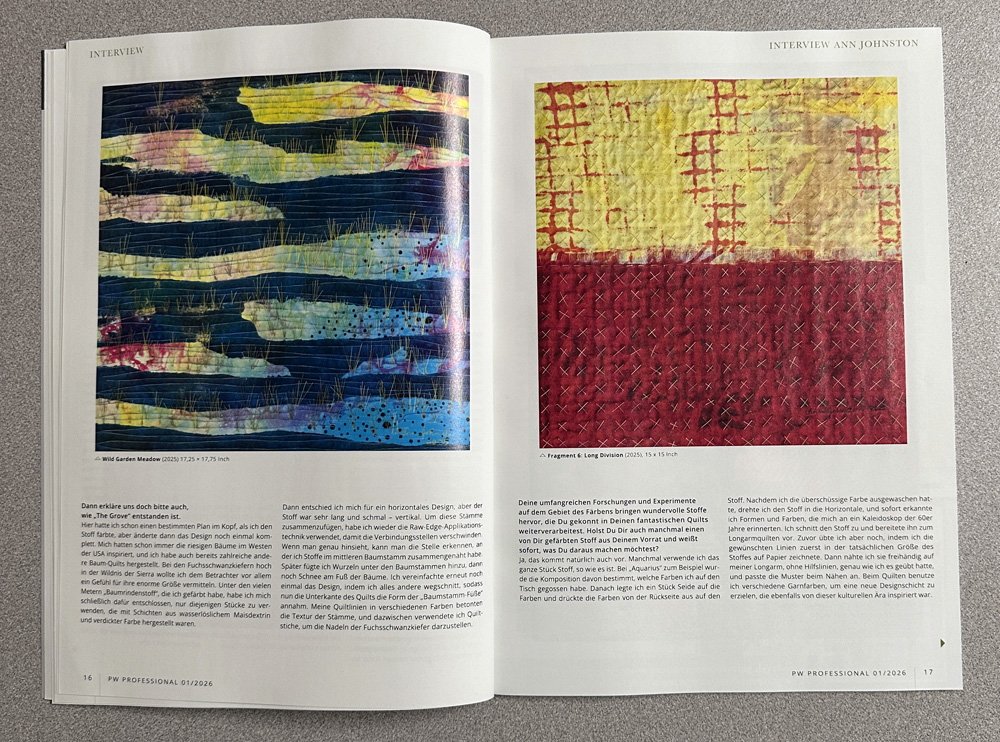
Here, I already had a specific plan in mind when I dyed the fabric, but then completely changed the design. I’ve always been inspired by the giant trees of the Western USA, and I’ve made numerous other tree quilts, but with the foxtail pines high in the Sierra wilderness, I wanted to convey their enormous size. Of the many yards of “bark fabric” I dyed, I ultimately decided to use only those pieces made with layers of water-soluble corn dextrin and thickened dye. I then decided on a horizontal design, but the fabric was very long and narrow—vertical. To join these trunks together, I again used the raw-edge appliqué technique to conceal the joins. If you look closely, you can see where I sewed fabrics together in the center of the tree trunk. Later, I added roots under the tree trunks, then snow at the base of the trees. I simplified the design once again by cutting away everything else, so that the bottom edge of the quilt now took the shape of the tree trunks’ feet. My quilting lines in different colors emphasized the texture of the trunks, and in between, I used quilting stitches to represent the foxtail pine needles.
Your extensive research and experimentation in dyeing produces wonderful fabrics that you skillfully incorporate into your fantastic quilts. Do you sometimes pull a piece of fabric you’ve dyed yourself from your stash and immediately know what you want to make with it?
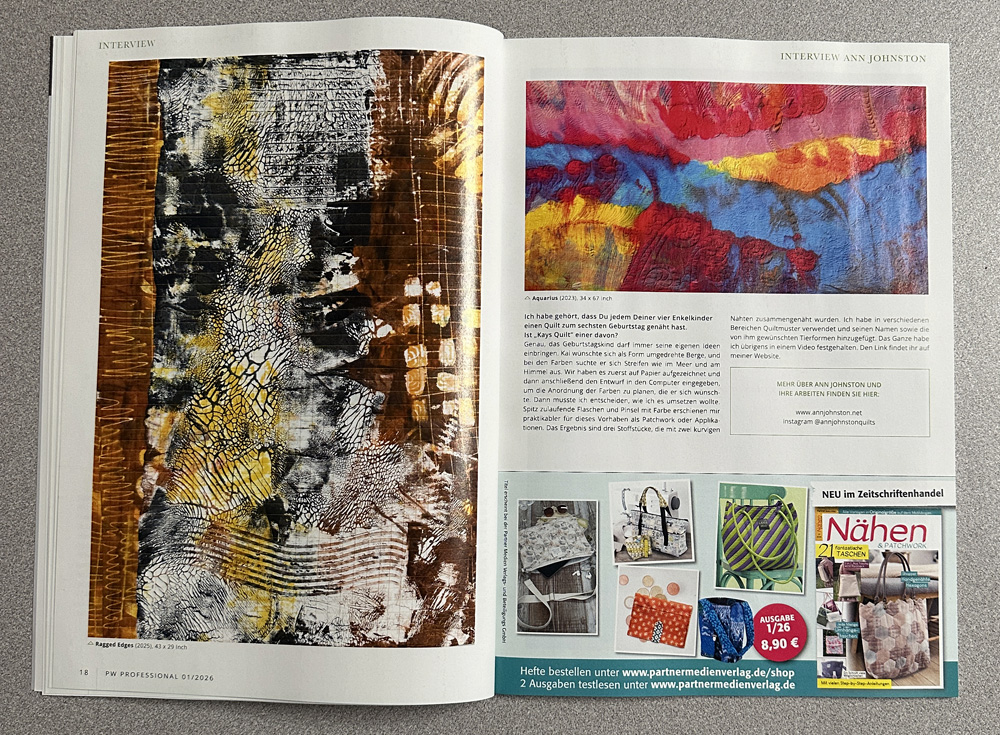
Yes, of course, that happens. Sometimes I use the entire piece of fabric as is and cover it with another layer of fabric with a completely different pattern. For “Aquarius,” for example, the composition was determined by which colors I poured onto the table. I then placed a piece of silk on top of the colors and pressed the colors onto the fabric from the back. After washing out the excess dye, I turned the fabric horizontally and immediately recognized shapes and colors that reminded me of a 1960s kaleidoscope.
I trimmed the fabric and prepared it for longarm quilting. Before doing that, I practiced by first drawing the desired lines on paper, the actual size of the fabric. Then I sewed them freehand on my longarm, without guidelines, just as I had practiced, adjusting the patterns as I went. When quilting, I use different thread colors to create a new layer of design, also inspired by this cultural era.
I heard that you made each of your four grandchildren a quilt for their sixth birthdays. Is “Kai’s Quilt” one of them?
Exactly, the birthday child is always asked to contribute their own ideas. Kai wanted upside-down mountains as the shape, and for the colors, he chose stripes like those in the sea and the sky. We first sketched it out on paper, then entered the design into the computer to plan the color arrangement he wanted. Then I had to decide how to implement it. Tapered bottles and brushes of paint seemed more practical for this project than patchwork or appliqué. The result is three pieces of fabric sewn together with two curved seams. I used quilting patterns in various areas and added his name and the animal shapes he requested. I even recorded the whole thing in a video. You can find the link on my website.